Draft Framework — For Discussion Purposes Only

Broward County Affordable Housing Initiative.

A public-private framework for workforce and affordable housing development. Layered capital stack. Tax-advantaged returns. Permanent affordability through Community Land Trust structure.

March 2026
Broward County, Florida
Confidential
Glossary
01 — Executive Summary

The wealth is in the land.

Broward County faces one of the most acute housing affordability crises in the United States. A convergence of expiring CRA districts, incoming Opportunity Zone 2.0 designations, and $85M+ in redirected TIF funding creates a rare window for a transformative public-private housing program.

0%
Cannot afford
median home
0%
Renter households
cost-burdened
+0%
Median home price
since 2020
$0
Average monthly
market rent
The Gap

An affordable rent threshold for low-to-moderate income households is $919 per month — a gap of $1,584 every month against market rates. This is not just a social issue. It is an economic competitiveness crisis.

The Origin

This started with one man
who refused to look away.

In the early 1990s, Fort Lauderdale's downtown had a problem the city couldn't solve by force. A tent city — at its peak, 400 people crammed under tarps in a half-acre parking lot across from City Hall — had become a fixture of the financial district. The city had tried bum sweeps, garbage can bans, and forced clearing. None of it worked. The encampment grew. Infectious disease spread. The Salvation Army urged closure.

At a time when over 5,000 individuals were homeless in Broward County and fewer than 350 shelter beds existed, H. Wayne Huizenga — the only person in American history to build three Fortune 500 companies — challenged the financial district's business leaders to do something real. Not a study. Not a committee. A building.

The result was Broward Partnership for the Homeless. Incorporated in 1997. Doors opened February 1, 1999, on the Huizenga Campus at 920 NW 7th Avenue. The tent city closed 11 days later. Over 32,000 individuals and families have been served since.

H. Wayne Huizenga (1937–2018)

Founded Waste Management, Blockbuster Video, and AutoNation — the only person to take three companies to the Fortune 500. First person to own teams in three major professional sports leagues simultaneously (Dolphins, Marlins, Panthers). 1997 World Series champion. Man of the Centennial, Fort Lauderdale (2010).

Wayne and wife Marti donated over $100 million to South Florida institutions. The Huizenga Family Foundation (est. 1987) continues to fund community organizations across Broward County. The campus that bears their name remains the largest comprehensive homeless services center in the county.

Huizenga Campus — By the Numbers
57K Square Feet
498 Emergency Beds
32K+ Individuals Served
1.2M Meals / Year
1993

Tent City & The County Plan

Broward County Commissioners adopt the Homeless Initiative Plan calling for a 200-bed Assistance Center. Over 5,000 homeless, fewer than 350 shelter beds. Tent city grows across from City Hall.

1997

BPHI Incorporated

Broward Partnership for the Homeless, Inc. formed as a private/public alliance. Business, financial, legal, medical, and community leaders join the founding board. Wayne Huizenga's challenge to the financial district becomes an organization.

1999

Doors Open on the Huizenga Campus

February 1: The Central Homeless Assistance Center receives its first clients. February 12: Tent city closes permanently. Frances Esposito, who came from Camillus House in Miami, leads operations for the next 25 years.

2023

Seven on Seventh Opens

BPHI completes its first affordable housing development — 72 units of mixed-use housing adjacent to the Huizenga Campus. From shelter operator to housing developer. The mission evolves.

2026

The Next Chapter

Aspire 1650 (90 units) in the FHFC pipeline. Heritage Crossing (~300 units) in active negotiation. A capital framework designed to attract generational investment. The Huizenga legacy scales.
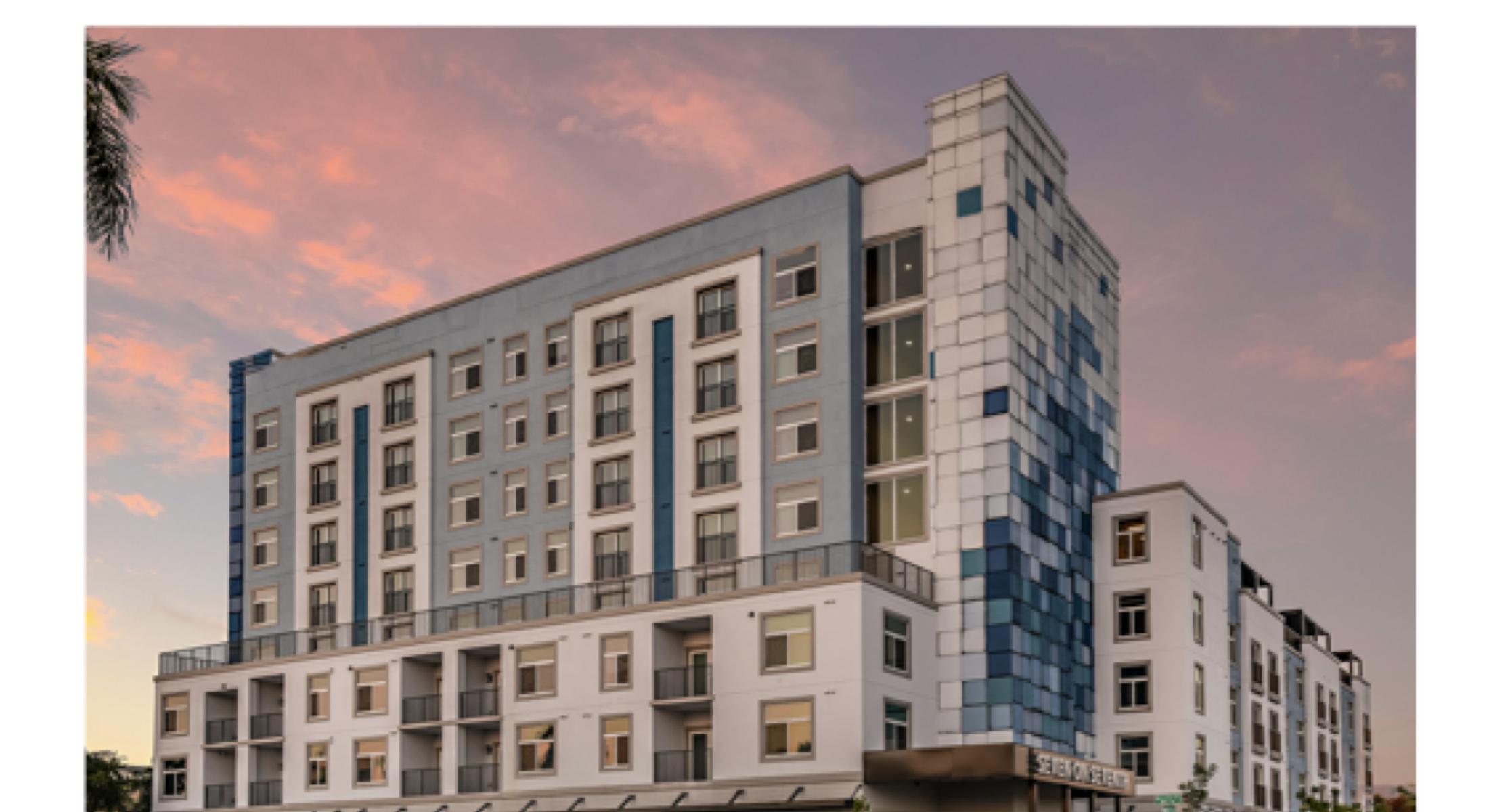
Seven on Seventh — 72-unit affordable housing development by Broward Partnership for the Homeless

Seven on Seventh — 72 units — Adjacent to Huizenga Campus — Completed 2023 — Photo: Green Mills Group

Why Legacy Matters to This Framework

Wayne Huizenga didn't just write a check. He challenged an industry — the financial district — to invest in a solution alongside government. That public-private partnership model is the DNA of everything on this page. The framework we propose extends this legacy to UHNW family offices: not charity, but architecture. You don't get wealthy without real estate — and this is real estate that compounds. Land that appreciates on your family's balance sheet for generations. Housing that serves the workforce your community depends on. A namesake that does good in perpetuity. In the current economic climate, with markets volatile and paper assets uncertain, permanently appreciating land is the smartest play available. The same model Wayne built. The next scale.

Historical sources: Sun-Sentinel reporting (2014, 2018, 2024), BPHI.org, Leo Goodwin Foundation, Broward County Commission records (December 1993), Fort Lauderdale Historical Society, GFL Alliance obituary (March 2018). Wayne Huizenga biography sourced from New Netherland Institute, Automotive Hall of Fame, CNBC, ESPN, and Nova Southeastern University.
02 — The Housing Crisis

Broward by the numbers.

The scale of Broward's housing gap demands immediate, coordinated action across every level of government and the private sector.

Metric Data Point Implication
Median home price increase since 2020 +67% Homeownership out of reach for most
Average market rent $2,500/mo Far exceeds workforce budgets
Affordable rent threshold (LMI) $919/mo $1,584/month gap per household
Cost-burdened renter households ~62% Majority spending 30%+ on rent
Residents who cannot afford median home 93% Near-universal workforce housing need
Tourism / hospitality workforce Significant Sector most impacted by housing gap
Economic Impact

The Greater Fort Lauderdale Chamber of Commerce has noted that Broward is engaged in "an all-out war for talent" — a war it risks losing if workforce housing is not addressed at scale.

03 — The Program Framework

The capital stack —
how it works.

An integrated capital stack where multiple funding sources layer on top of each other, maximizing both the scale of housing produced and the financial return for private investors.

01
Private Capital
UHNW Family Offices / QOF Investors
Acquire land; hold as long-term generational asset on the family balance sheet.
02
Federal Incentives
LIHTC, OZ/QOF, NMTC, HUD, HOME
Tax credits and grants offset development cost — reducing effective cost of capital toward zero.
03
State Programs
SAIL, SHIP (Florida)
Subordinate loans and gap financing from State Housing Initiatives Partnership and State Apartment Incentive Loan programs.
04
County / City
TIF Trust Fund, Impact Fee Waivers, Land Disposition
Public land access plus $85M+ in redirected CRA funds from expiring Tax Increment Finance districts.
05
CLT Structure
Community Land Trust Entity
Land held permanently by the trust; units sold or rented separately. Locks in affordability while land appreciates.
04 — Investor Value Proposition

Tax-advantaged
generational asset.

For ultra-high-net-worth investors and family offices, this program is structured as a long-term tax-advantaged asset — not a short-term yield play.

Tax Tool Benefit Time Horizon
Qualified Opportunity Fund (QOF) Defer and eliminate capital gains tax on appreciation 10+ year hold
Low-Income Housing Tax Credit (LIHTC) Dollar-for-dollar federal tax credit over 10 years 10 years
New Markets Tax Credit (NMTC) 39% credit on qualified equity investment 7 years
1031 Exchange into Fund Roll property sale proceeds, defer capital gains Ongoing
Family Limited Partnership (FLP) Generational asset transfer with valuation discounts Multi-generational
Charitable Lead / Remainder Trust Deduction now; asset passes to heirs later Estate planning
Key Insight

There is rich and there is wealthy. Income makes you rich. Land makes you wealthy. The land itself — held by the family office entity or CLT — appreciates over time as a balance sheet asset, independent of the affordable housing restriction on the units. You don't get wealthy without real estate. This program puts permanently appreciating land on your family's balance sheet while housing the workforce that makes your community function. That is the generational wealth mechanism.

05 — Ownership Model

Community Land Trust —
permanent affordability.

The CLT structure solves the core tension between investor returns and permanent affordability by separating land ownership from unit ownership.

Land Ownership — Investor / CLT

The CLT or family office-controlled entity owns the land in perpetuity. The land never re-enters the speculative market. The family office retains a long-term appreciating land asset on the family balance sheet. A third-party property management company maintains all units to current living standards.

Unit Ownership — Residents

Residents and buyers own their individual units as condominiums or homes. When a unit is sold, appreciation is shared between the seller and the CLT, keeping the unit affordable for the next buyer. This creates a real ownership path for workforce families while preserving affordability permanently.

Explore

Condominium ownership within a CLT structure — where residents own units but land rights remain with the trust — is a model worth testing in Broward. This could open the program to seasonal and part-time residents as well as full-time workforce tenants.

06 — Target Geography

OZ + CRA overlap —
18 tracts in Broward.

The land acquisition strategy focuses on the intersection of active Opportunity Zone census tracts, expiring CRA districts, and municipal surplus land under Florida Statute 166.0451.

Fort Lauderdale

7 OZ Tracts

Active CRA (NW-Progresso-Flagler + Central City). Highest OZ density in the county.

Lauderdale Lakes

4 OZ Tracts

High OZ density. Workforce and LMI population. Phasing CRA presents acquisition window.

Hollywood

1 OZ Tract

Active Beach + Downtown CRA. Tourism and hospitality workforce hub.

Hallandale Beach

2 OZ Tracts

Active CRA. Miami border growth corridor with strong demand dynamics.

Lauderhill

2 OZ Tracts

2 active OZ tracts with affordable land availability and strong community need.

Dania Beach

1 OZ Tract

Airport corridor with strong workforce housing demand from FLL operations.

OZ 2.0 — Critical Timing

The current OZ 1.0 program expires at end of 2028. A new OZ 2.0 designation round opens July 1, 2026, with new tracts taking effect January 1, 2027. Partners already engaged with Broward County officials can advocate for OZ 2.0 nomination of target parcels. Florida has 1,360 census tracts eligible for OZ 2.0 — the map may expand significantly in Broward.

07 — Government Partnership Strategy

Four tiers of
public capital.

Every level of government has tax authority, incentive programs, and institutional motivation to participate in this framework.

Federal

  • LIHTC — Primary federal tool; dollar-for-dollar credit over 10 years
  • QOF / OZ — Capital gains deferral and elimination
  • NMTC — For mixed-use/commercial components
  • HUD HOME — Gap financing for affordable units
  • CDBG — Infrastructure and community facilities

State of Florida

  • SAIL — Subordinate loans for affordable multifamily
  • SHIP — Homeownership and rental assistance
  • FHFC — Administers LIHTC allocations statewide

Broward County

  • Housing Trust Fund — $85M+ from expiring CRA TIF redirections through FY2032
  • Land Disposition — County-owned surplus parcels for affordable development
  • CRA Phase-Out — Redirecting expiring TIF toward housing
  • Incentives — Impact fee waivers, density bonuses, and parking reduction to zero for units at/below 60% AMI near transit
  • CRA Investment — $127.4M total awarded incentives; 80% of in-progress allocation ($45.9M) directed to mixed-use affordable housing

Municipal (City-by-City)

  • FL Statute 166.0451 — Surplus land inventory for affordable housing
  • Density Bonuses — 1 AH unit at 50% AMI = 19 market rate units; at 30% AMI = 25 market rate units (AHAC 2024)
  • Expedited Permitting — Fast-track affordable housing projects
  • Parcel Access — Direct land transfer or long-term ground lease
08 — The Banking Layer

The Circle of Life —
perpetual reinvestment.

Private banking relationships become the engine that makes the entire capital stack self-sustaining — not a one-time transaction, but a perpetual reinvestment cycle.

Leverage Private Banking Relationship

UHNW family office engages existing relationship with JPMorgan, Goldman, Citi, Wells, or BofA Private Bank.

Bank Provides Acquisition + Construction Loan

Secured against CLT land asset. Low LTV risk for the bank. CRA-motivated, below-market interest rate.

LIHTC Equity Bridge Loan

Bank advances credit investor equity before final pay-in, filling the construction-period gap.

Federal + State Incentives Layered In

LIHTC, OZ, HOME, SAIL reduce effective cost of capital to near zero.

Development Completes

Units rented or sold. Rental income and/or condo proceeds begin servicing debt.

Permanent HUD 221(d)(4) Loan Replaces Construction Debt

Non-recourse, 40-year FHA-insured mortgage locks in a low fixed rate for the life of the asset.

Land Asset Appreciates

CLT land held by family entity grows in value independent of unit affordability restrictions.

Family Office Refinances — Pulls Equity

Cash-out refinance or recapitalization at higher land valuation frees capital for redeployment.

Equity Redeployed into Next Acquisition

New OZ tract, new parcel, new development. The cycle restarts — permanently.

CRA Mandate — Why Banks Need This Deal

Under the Community Reinvestment Act, every major bank is graded by federal regulators on how well it deploys capital in low-to-moderate income communities. A poor CRA rating can block a bank's mergers, acquisitions, and expansion plans. They are not doing you a favor — they need your deal. CRA-motivated loans come at below-market interest rates, and banks can simultaneously provide the loan and invest as LIHTC equity buyers.

Banking Tool Function CRA Value to Bank
Construction-to-Perm Loan Finances the build; converts to permanent mortgage at CO High
LIHTC Equity Bridge Loan Advances tax credit equity before investor pays in full High
Land Acquisition Loan Secured against CLT land; low risk, predictable collateral Medium
LIHTC Tax Credit Investment Bank buys credits directly — dollar-for-dollar tax offset Very High
HUD 221(d)(4) Permanent Debt FHA-insured 40-year non-recourse multifamily loan High
Syndication Services Syndicates LIHTC credits to corporate investors; earns fee High
The Ideal Structure

In the ideal structure, the same private bank provides the acquisition loan, syndicates the LIHTC credits to corporate buyers, and holds the permanent debt — earning fee income at every stage while maximizing its CRA rating. The bank wins. The family office wins. Residents win. The county wins. No one is doing charity.

09 — Proof of Concept

Seven on Seventh —
already executed.

Seven on Seventh — 72-unit affordable housing by BPHI

Seven on Seventh — 72 units — NW-Progresso CRA — Completed 2023 — Photo: Green Mills Group

Seven on Seventh — Completed

Broward Partnership for the Homeless (BPHI) has already demonstrated this model works in this exact market. Seven on Seventh is a completed 77-unit mixed-use affordable development in the NW-Progresso CRA — fully stabilized, construction loan repaid, and workforce training hub operational.

77 Units Built
95%+ Stabilized Occupancy
Debt Free — Loan Repaid
Active Workforce Training Hub

Execution Track Record

Construction financing fully repaid. CRA Streetscape forgivable loan closed. Multiple subordinate financing sources closed and deployed. Commercial space leased and activated as a workforce training hub serving the NW-Progresso community.

BPHI's First Joint Venture

Seven on Seventh was BPHI's first joint venture in affordable housing development — a 72-unit mixed-use community adjacent to the Huizenga Campus. Half workforce housing, half Continuum of Care referrals. Rents from $400–$1,200/month. Funded by FHFC LIHTC (March 2019), Jim Moran Foundation, and Broward County.

09B — Next in Pipeline

Aspire 1650 —
90 units, Pompano Beach.

BPHI's second development is in the FHFC pipeline under RFA 2025-103 with FHFC board approval secured March 28, 2025. GC bids due April 3, 2026. Financial closing and groundbreaking targeted Q3 2026. All figures from the filed FHFC application.

Aspire 1650 — Gallo Herbert Architects

Aspire 1650 — 160 units (Phase 1: 90) — NW 31st Ave & Blount Rd, Pompano Beach — Gallo Herbert Architects — May 2025

Project Overview

LocationNW 31st Ave & Blount Rd, Pompano Beach
Units90 (Phase 1 of 160 total)
Unit Mix8 Studio · 68 1BR/1BA · 14 2BR/2BA
Building8-story high-rise, single building
GSF83,712 SF
Parking160 surface spaces
ArchitectGallo Herbert Architects (GHA)
Development PartnerGreen Mills Group
FHFC ApplicationRFA 2025-103 (#2025-362CSA)

Timeline

FHFC Application FiledJan 21, 2025
FHFC Board ApprovalMar 28, 2025
GC Bids DueApr 2, 2026
Financial ClosingQ3 2026
50% ConstructionQ2 2027
Certificate of OccupancyQ4 2027
100% LeasedQ1 2028
Stabilized OperationsQ3 2028
10 — Deal Model I — FHFC-Filed

Aspire 1650 —
the real numbers.

All figures below are from the filed FHFC RFA 2025-103 application (#2025-362CSA). FHFC board approval secured March 28, 2025. GC bids due April 3, 2026. Construction targeted Q3 2026. Pro forma will be revisited upon final construction bid and equity investor commitment.

Development Budget — FHFC Application

Line Item Cost % of TDC Per Unit
Land (TBD)$2,500,0006%$27,778
Hard Cost Construction$23,857,92060%$265,088
Rec / Owner / Green / FF&E$483,9001%$5,377
Hard Cost Contingency$1,192,8963%$13,254
Developer Fee$4,929,06412%$54,767
Construction Interest$1,494,0004%$16,600
Financing Fees / FHFC Fees$850,4472%$9,449
Operating Reserve (5% TDC)$1,549,3334%$17,215
Soft Costs$3,107,4908%$34,528
Total Project Costs$39,965,050100%$444,056

Capital Stack — Sources (FHFC Application)

LIHTC Equity $28.0M · 70%
SAIL $5.6M · 14%
Def Fee 5%
Land 4%
Other 7%
Source Amount % of TDC Notes
LIHTC Limited Partner Equity$28,047,19570%9% housing credits — largest single source
FHFC SAIL$5,570,90014%State Apartment Incentive Loan
Deferred Developer Fee$2,017,8555%Developer fee deferred to close gap
Deferred Land$1,500,0004%Land value contributed / deferred
NTHF / HOME$1,150,0003%National Housing Trust Fund / HOME program
BPHI Reloan (McCormick)$850,0002%Internal BPHI subordinate loan
FHFC ELI$529,1001%Extremely Low Income supplemental
Broward County$300,0001%County contribution
Total Project Financing$39,965,050100%

Construction Period Financing

SourceAmount% of TDC
Construction Loan$18,000,00045%
LIHTC Equity During Construction$14,023,59835%
Note on Pro Forma

The pro forma will be revisited once final construction bids are received (due April 3, 2026) and equity investor commitments are secured. Figures above reflect the filed FHFC application. Broward County has agreed to construct off-site drainage improvements and site elevation work on the adjacent county-owned parcel at county expense.

Source: FHFC RFA 2025-103 Application (#2025-362CSA), filed January 21, 2025. Unit mix per March 9, 2026 Fact Sheet. Timeline per March 2026 update. GC bids solicited February 26, 2026 to Gomez Construction, Lemark Construction, Pirtle, and Royal American Management.

11 — Investor Return Summary

Three return streams —
one compounding asset.

The UHNW investor receives returns through three independent channels, each operating on a different time horizon. Combined, they produce institutional-grade after-tax performance.

12–15%
Blended After-Tax
IRR (10-Year)
9.4%
Cash-on-Cash
Return
~0%
Effective Tax Rate
on Deployed Capital

Stream 1: LIHTC Tax Credits

Total 10-year LIHTC credits: $20.1M face value. Investor cost for credits: $10.78M at $0.92 pricing. Net tax benefit: $9.32M over 10 years. Effective annual yield on LIHTC equity: ~8.6% tax-equivalent.

Stream 2: QOF / Opportunity Zone

$5.4M invested through QOF. Capital gains deferred years 1–10, then all appreciation is tax-free. Projected tax-free gain at Year 10: $2.1M–$2.8M. 6% preferred return = $324K/year cash distributions.

Stream 3: Cash Flow + Land Appreciation

Annual cash flow after debt service: $509K. Land value appreciation (CLT-held): $1.8M basis projected to $2.8–$3.2M at Year 15. Generational transfer via FLP at discounted valuation.

Combined 10-Year Return

Total capital deployed: $16.18M (LIHTC + QOF). Total credits received: $20.1M. Total cash distributions: $5.09M. Tax-free OZ appreciation: $2.1–$2.8M. Land asset value: $2.5–$2.8M.

Sensitivity Analysis

Scenario Change Cash-on-Cash IRR
Base Case As modeled 9.4% 12–15%
15% Construction Overrun +$2.52M hard costs 7.1% 10–12%
10% Rent Reduction -$138K revenue 6.9% 10–11%
OZ 2.0 Portfolio Expansion Additional parcels at similar basis 9.4% 12–15%
12 — Deal Model II

Heritage Crossing —
the real deal.

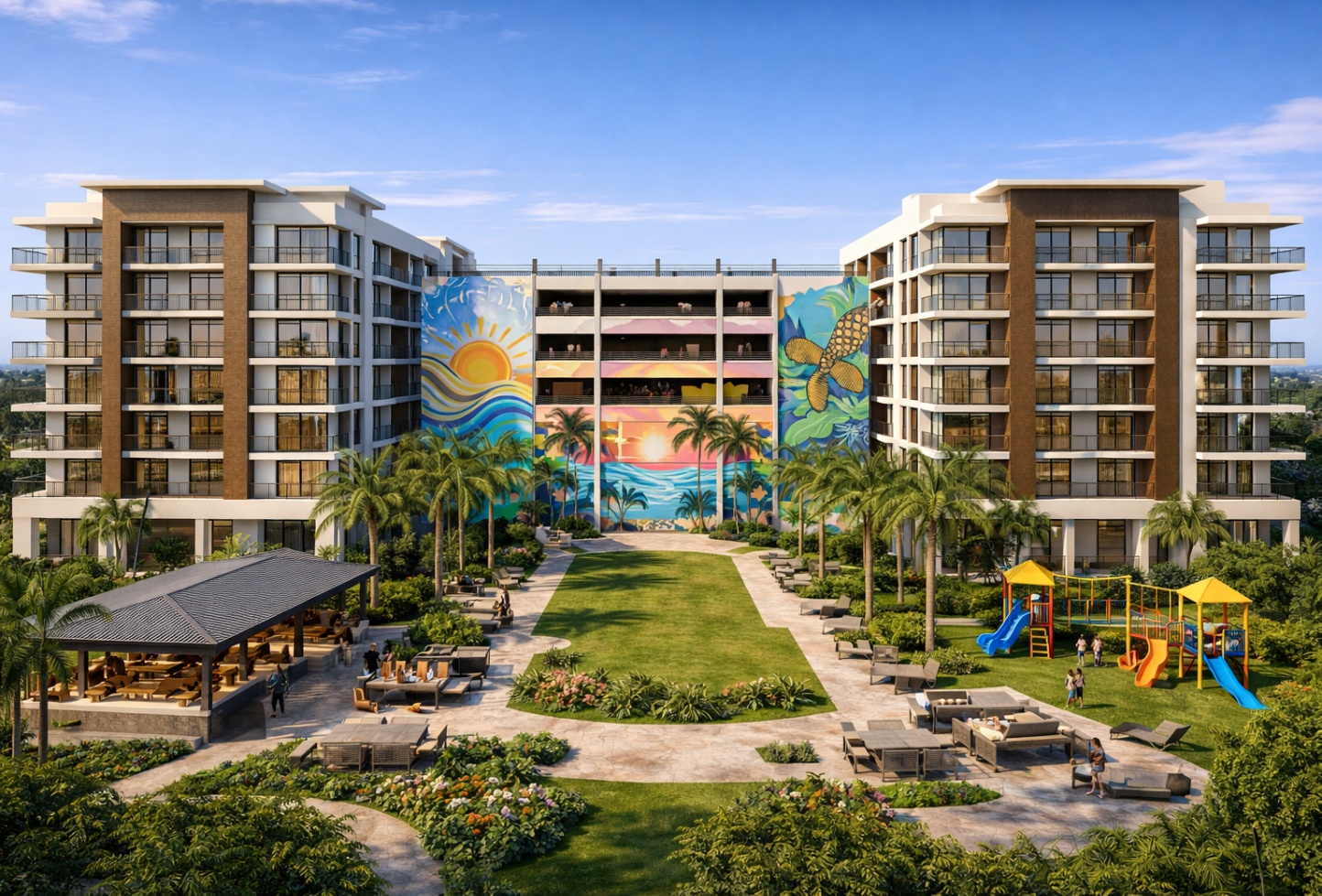
A 353-unit mixed-use affordable housing community on the 3.03-acre USPS Post Office site at 400 NW 7th Avenue, Fort Lauderdale. Active ground-floor uses designed for Avenue of the Arts — gallery, cafe, bookstore, art co-op. Six stories of structured parking with residential above. Unit sizes based on Seven on Seventh. AMI levels 30–80% with workforce and special populations housing. This is not hypothetical — conceptual design is complete, Green Mills Group is running financial models, and the site is in the NW-Progresso CRA with a confirmed extension through 2035.

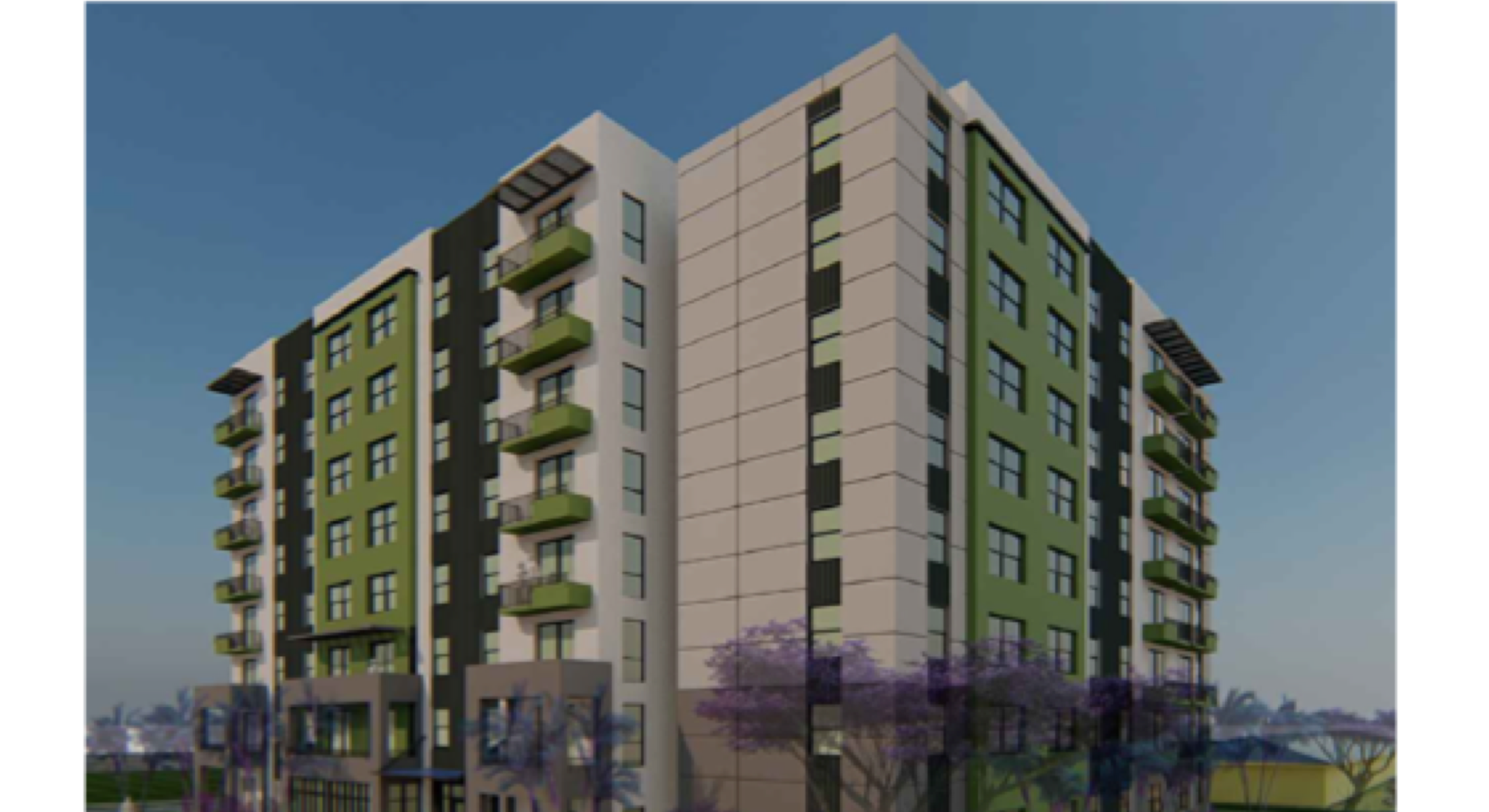
Heritage Crossing — 300-unit mixed-use affordable housing concept at 400 NW 7th Avenue, Fort Lauderdale — Two 8-story buildings with central courtyard, public art mural, playground, and summer kitchen

Heritage Crossing — Conceptual Design — 300 units — Two 8-story buildings — Central courtyard with summer kitchen & playground — Public art mural on structured garage — 400 NW 7th Avenue, Fort Lauderdale

Building Configuration

Two identical 8-story structures in parallel configuration. 150 units per building. Podium-style wrapped garage (6 levels, 332 spaces). Ground level with residential liner units, lobby, amenities, and commercial/nonprofit partnership space.

Central Courtyard

Covered summer kitchen with built-in grills and dining. Children’s playground with shade canopy. Event lawn. Native tropical landscaping with rainwater bioswales. String lighting for evening ambiance. Indoor-outdoor flow from both buildings.

Glavovic Studio — Conceptual Design — April 9, 2026

353 units (263 x 1BR, 68 x 2BR, 22 x 3BR). Unit sizes based on Seven on Seventh (675 / 1,013 / 1,350 SF). 6 stories of parking (332 spaces; 7th floor possible with city approval = 392). 502,697 total GSF. Active ground-floor uses designed for Avenue of the Arts — gallery, cafe, bookstore, art co-op. Post office retained on ground floor. Design employs horizontal louvers and massing breaks to create a strong visual identity while reducing perceived scale.

Heritage Crossing — Glavovic Studio Concept — Pedestrian Street View — Avenue of the Arts — April 2026

Pedestrian View — Avenue of the Arts frontage — Active ground-floor uses

Updated Unit Schedule — April 2026
353 Total Units
503K Total GSF
332 Parking Spaces
29K Commercial SF

Conceptual design only. Final quantities to be determined during design phases. Green Mills Group running financial models on bond/4% deal structure. Margi Nothard traveling through April 26.

View April Concepts (PDF) →
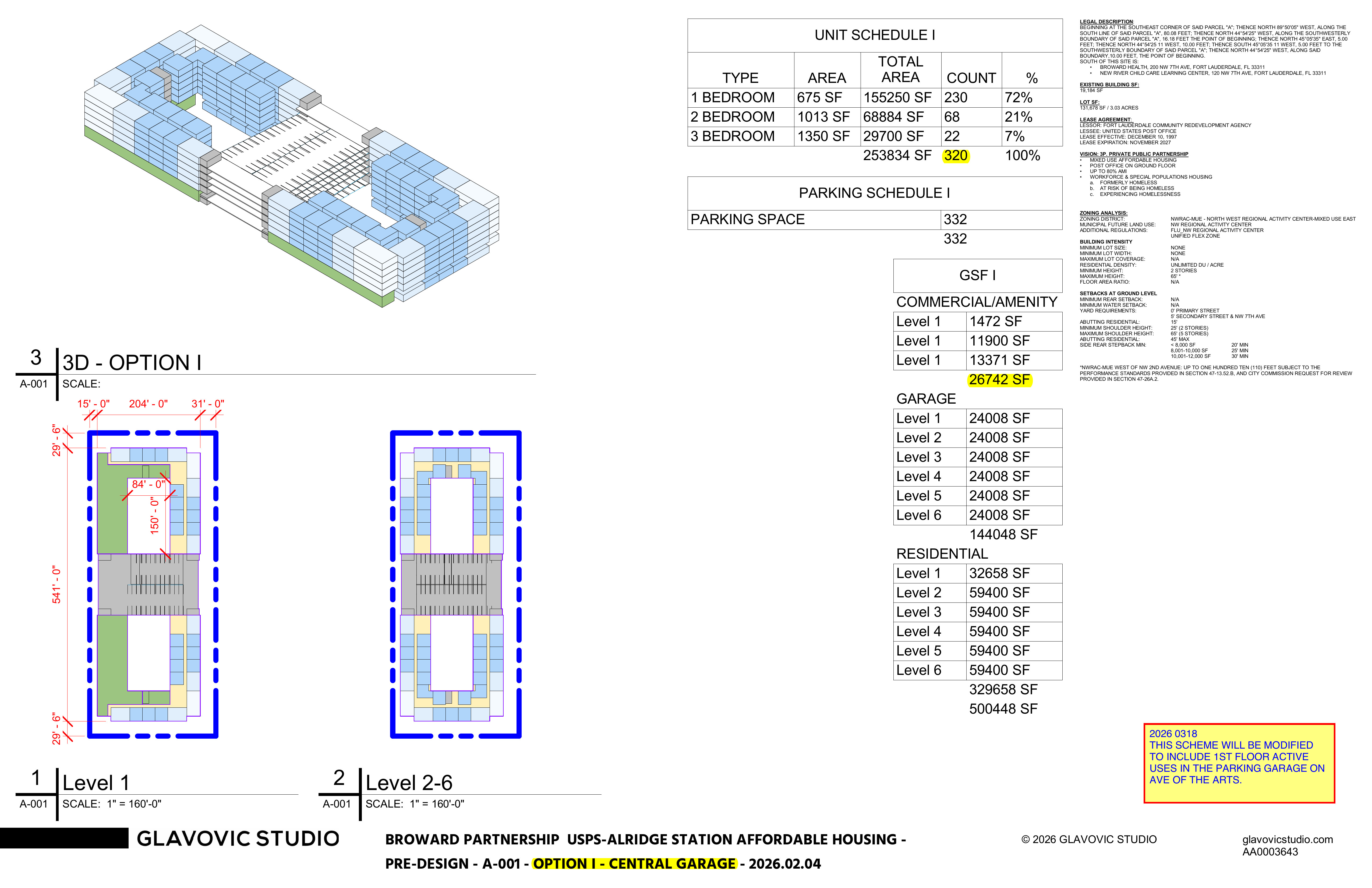
Glavovic Studio — Earlier Massing Studies — March 18, 2026 Heritage Crossing — Glavovic Studio Option I Central Garage — 320 Units

Schedule I — Central Garage. 320 units (230 x 1BR, 68 x 2BR, 22 x 3BR). 6 stories. 332 parking spaces. 26,742 SF commercial/amenity. 500,448 SF total. Post office retained on ground floor.

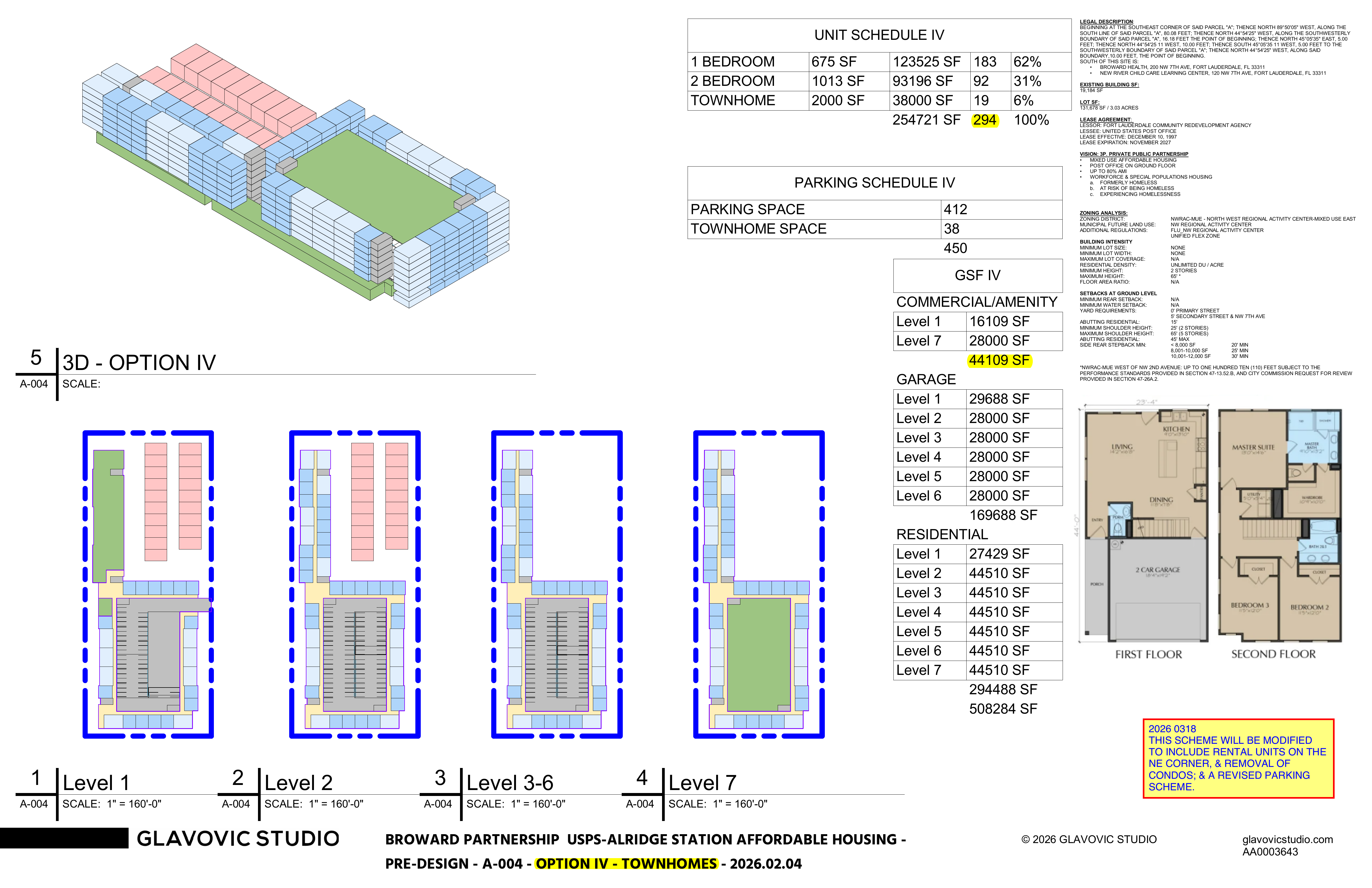
Heritage Crossing — Glavovic Studio Option IV Townhomes — 294 Units

Schedule IV — Townhomes. 294 units (183 x 1BR, 92 x 2BR, 19 x 2,000 SF townhomes). 7 stories. 450 parking spaces (412 garage + 38 townhome). 44,109 SF commercial/amenity. 508,284 SF total.

Earlier massing studies exploring two configuration options. April 2026 concept refines Option I with active ground-floor uses for Avenue of the Arts.

View March Massing Studies (PDF) →

Site & Entitlement Details

Parameter Detail Source / Date
Address 400 NW 7th Avenue, Fort Lauderdale, FL 33311 CRA Board Minutes, Feb 10, 2026
Site Size 3.02 acres / 131,679 SF CRA Board Minutes, Feb 10, 2026
Current Use US Post Office (15,198 SF building) Existing conditions
USPS Lease Expiration December 11, 2027 Lease agreement (effective Dec 6, 1997)
Owner City of Fort Lauderdale (acquired with $1.8M CDBG + $1.85M construction) CRA Board Minutes, Feb 10, 2026
Transfer Path City → CRA → Broward Partnership (at reduced or no cost) CRA Public Record, Feb 2026
Fair Market Value $10M+ ($75–$100/SF) Bob Wojcik, CRA Housing Mgr, Feb 2026
Zoning NWRAC-MUE (NW Regional Activity Center Mixed Use East) City zoning records
Density Unlimited DU / acre NWRAC-MUE regulations
Height 65 ft by right; 110 ft with AH bonus CRA memo, Feb 2026; FAA limit 200 ft
LLA Tax Exemption 100% for units <80% AMI; 75% for 80–120% AMI Live Local Act (FL SB 102, 2023)
CRA Extension Through November 7, 2035 (ILA signed May 20, 2025) Interlocal Agreement, May 2025
Adjacent Broward Health (250 NW 7th Ave), New River Child Care (120 NW 7th Ave) Legal description
Architect Glavovic Studio (conceptual renders complete; 353-unit Option I refined for Avenue of the Arts) Pre-design Feb 2026; massing March 18; concept renders April 9, 2026
Proposed Terms — Per CRA Public Discussion (February 2026)

Minimum 250 multifamily apartment units. At least 50% of units reserved for households at or below 60% AMI. Project may be developed in phases. 10-year reverter clause for building permits. Developer may transfer to affiliated entity or joint venture. Bi-annual progress reporting to CRA.

Unit Schedule — April 2026 Concept

Type Unit SF Count Total SF % of Units
1 Bedroom 675 SF 263 177,525 SF 75%
2 Bedroom 1,013 SF 68 68,884 SF 19%
3 Bedroom 1,350 SF 22 29,700 SF 6%
Total Residential 353 276,109 SF 100%
Building Component Area (SF) Notes
Residential (6 levels) 329,658 SF Levels 1–6 residential
Commercial / Amenity (3 levels) 26,742 SF Post office + ground floor active uses + amenity
Structured Parking (6 levels) 144,048 SF 332 spaces (1.04:1 ratio)
Total Gross SF 500,448 SF

Development Budget

Line Item Cost Per Unit Notes
Land Acquisition $0 $0 CRA conveyance at no cost; $10M+ value contributed as development incentive
Hard Costs (Construction) $72,000,000 $225,000 $144/SF on 500K GSF; includes structured parking. RS Means 2026 South FL.
Soft Costs (A&E, Legal, Permits) $10,800,000 $33,750 15% of hard costs; LIHTC compliance + HUD Change of Use process
Developer Fee $7,200,000 $22,500 10% of hard costs; split between BPHI and development partner per 7 on 7th model
Financing Costs $5,400,000 $16,875 24-month construction at ~6.5% avg outstanding balance
Reserves $1,600,000 $5,000 6-month operating + $300/unit/yr replacement reserve (FHFC requirement)
Total Development Cost $97,000,000 $303,125

Capital Stack — Sources

LIHTC Equity $40.7M · 42%
QOF $20.4M · 21%
FHA Debt $20.4M · 21%
State $7.7M · 8%
CRA/City $7.8M · 8%
Source Amount % of TDC Terms / Mechanism
LIHTC Equity (9% credits) $40,700,000 42% 10-year credit period. Priced at $0.92/credit. Phased with 4% credits if needed for scale.
Private Capital (QOF) $20,400,000 21% UHNW family office via Qualified Opportunity Fund. 10-year hold = tax-free appreciation. 6% pref.
Permanent Debt — FHA 221(d)(4) $20,400,000 21% 40-year fully amortizing, non-recourse, ~5.25% fixed. 1.15x DSCR minimum.
State Programs (SAIL + SHIP) $7,700,000 8% SAIL subordinate at 0%, 50-year, cash-flow contingent. SHIP county allocation.
CRA / City Contributions $7,800,000 8% Land value ($10M+) conveyed as incentive + impact fee waivers + CRA streetscape funds. Modeled on 7 on 7th precedent ($285K forgivable loan).
Total Sources $97,000,000 100%

Stabilized Operating Pro Forma — Year 1

Line Item Annual Per Unit / Mo Notes
Gross Potential Rent $5,260,800 $1,370 avg 60% AMI: 1BR $1,250 · 2BR $1,550 · 3BR $1,850. 50%+ at 60% AMI per term sheet.
Vacancy & Collection Loss ($368,256) 7% — conservative for affordable with waitlist demand. 7 on 7th achieved 95%+ stabilization.
Other Income (commercial, parking, ancillary) $360,000 26,742 SF commercial at $13.50/SF + parking + laundry
Effective Gross Income $5,252,544
Operating Expenses ($2,080,000) $6,500/unit Management 6%, insurance, taxes (LIHTC abated), maintenance, reserves
Net Operating Income $3,172,544
Debt Service — FHA 221(d)(4) ($1,365,360) $20.4M at 5.25%, 40-yr amortization
Cash Flow After Debt Service $1,807,184 DSCR: 2.32x (well above 1.15x minimum)
12B — Heritage Crossing Investor Returns

$10M+ in contributed land.
Zero acquisition cost.

Because the CRA can convey the land at reduced or no cost, the entire $10M+ land value becomes a balance sheet asset for the investor from day one — an immediate equity position with no capital outlay for the parcel itself.

14–18%
Blended After-Tax
IRR (10-Year)
8.9%
Cash-on-Cash
Return
$10M+
Contributed Land
Value (Day One Equity)

Why This Deal Is Different

Building on the proven Aspire 1650 capital stack model at 3.5x scale. Pre-design complete by Glavovic Studio. Term sheet in negotiation with the CRA. The same development team, the same LIHTC + state + local layering — applied to a $10M+ contributed land asset with unlimited density zoning. The CRA extension through 2035 provides a decade-long runway for execution.

Combined 10-Year Return

Total capital deployed: $61.1M (LIHTC + QOF). Total credits received: ~$80M face value. Total cash distributions: $18.07M. Tax-free OZ appreciation: $8–$10M. Land asset value at Year 10: $14–$16M (3–4% annual appreciation on $10M+ contributed basis).

Proven Execution Model

Broward Partnership completed Seven on Seventh in this exact CRA district — 77 units, construction financing fully repaid, stabilized occupancy achieved, CRA partnership executed, and workforce training hub operational. The 400 NW 7th Ave project applies the same playbook at 4x scale with an established team, an engaged architect, and active government partnership.

12 — Target Populations

Who this serves.

The program is designed to serve multiple resident populations simultaneously within a single mixed-income development model.

Population Profile Housing Need
Workforce / Hourly Tourism, hospitality, service industry employees Affordable rental; proximity to jobs
Middle Income Young professionals, teachers, healthcare workers Workforce ownership; CLT condo model
Seasonal / Part-Time Snowbirds, secondary residence buyers Part-time condo ownership in CLT structure
LMI / Vulnerable Low-to-moderate income households Deeply subsidized rental; LIHTC units
Workforce Families School-age families priced out of market 2-3BR affordable homeownership
13 — Target Banking Partners

South Florida capital partners.

Institution Why Relevant Entry Point
JPMorgan Private Bank Largest private bank in the US; aggressive CRA program; active LIHTC syndicator Explore Existing Relationship
Bank of America / Merrill Major LIHTC investor and syndicator; strong CRA history in South Florida BofA Community Development Banking
Wells Fargo Private Bank Significant CRA lending history in Broward; affordable housing focus Wells Fargo Housing Finance
Citi Private Bank Global UHNW relationships; active in OZ and LIHTC investment Citi Community Capital
TD Bank Strong CRA performance in Southeast Florida; active construction lender TD Community Development Finance
Florida Community Loan Fund CDFI — fills gap where conventional banks will not; stacks with bank debt Direct application
14 — Open Questions

Talking points for
development.

Structure & Legal

  • Can a QOF and CLT be structured as the same entity, or must they be separate with a ground lease?
  • What are the limitations on investor returns in a combined LIHTC + QOF structure?
  • How does the CLT affordability covenant interact with condo association law in Florida?
  • Optimal QOF entity structure: single-asset vs. multi-asset fund?

Investor Proposition

  • Realistic 10-year IRR for a family office investing in a QOF-backed CLT housing project in Broward?
  • How to structure the FLP to maximize estate planning benefits while meeting QOF requirements?
  • Minimum investment threshold that makes tax benefits meaningful for a UHNW family office?
  • LIHTC syndicator selection and credit pricing negotiation strategy?

Government / Partnership

  • Which Broward CRAs are expiring soonest with surplus parcels identified for affordable housing?
  • Is the county willing to do a direct land transfer (ground lease at $1/year) to a CLT entity?
  • County preference for affordability period: LIHTC standard (30 years) or permanent CLT covenant?
  • County land disposition timeline and competitive process details?

Deal Model & Execution

  • Can the CLT condo model legally accommodate seasonal/part-time residents under Florida condo law?
  • Shared appreciation formulas: how to keep units affordable while giving residents meaningful equity?
  • Optimal unit mix (rental vs. ownership) for each target resident population?
  • Construction cost lock strategy: GMP vs. lump sum? Phase 2 pipeline capacity?
15 — Immediate Next Steps

Action items.

# Action Target / Contact
1 Pull BCPA Web Map — overlay OZ + CRA boundary layers; identify priority parcels bcpa.net
2 Contact Broward County Housing Finance Division — intro meeting (954) 357-4900 — Reference BPHI / Project 717
3 Request surplus land inventory under FL Statute 166.0451 Fort Lauderdale, Lauderdale Lakes, Hollywood first
4 Engage tax attorney — QOF + CLT hybrid structure Referral from BPHI or Greater Ft. Lauderdale Chamber
5 Monitor OZ 2.0 nomination window Opens July 1, 2026
6 Model financial scenarios for QOF + LIHTC + CLT stack Tax counsel + affordable housing finance consultant

This is a draft framework document prepared for discussion and partner outreach. All financial projections, tax benefit estimates, and program parameters are preliminary and subject to legal, financial, and feasibility review. This document does not constitute legal or financial advice. The sample deal models are presented for illustrative purposes only and are not securities offerings or investment solicitations. Site data sourced from Broward County Property Appraiser, City of Fort Lauderdale CRA public records, Florida Housing Finance Corporation, and publicly available government filings.

16 — Forward Vision

50,000 empty seats.
Thousands of acres.

Broward County Public Schools is the largest taxing authority in Broward County — collecting $1.016 billion in property taxes annually, more than the county government itself. The district operates 326 schools on thousands of acres. It has lost 37,700 students in the last decade. It has 50,000+ empty seats. It has identified 34 schools for closure. And it has no comprehensive plan for what comes next. We do.

$1.016B
Annual Property
Tax Revenue
50,000+
Empty Seats
Across District
34
Schools Flagged
for Closure

The Problem

BCPS enrollment dropped 17% since 2015 — nearly 37,700 fewer students — driven by the cost of living pushing families out of Broward, universal school vouchers expanding private enrollment, and charter school competition. The district faces a $94 million budget deficit. Phase 2 closures (approved January 2026) are shutting 6 schools, saving $10M/year. The superintendent says they are “a little bit less than halfway there.”

School (Phase 2 Closures) City Status
Sunshine ElementaryMiramarStudents to Fairway Elementary
Panther Run ElementaryPembroke PinesStudents to Chapel Trail & Silver Palms
Palm Cove ElementaryPembroke PinesStudents to Lakeside & Pines Lakes
North Fork ElementaryFort LauderdaleStudents to Croissant Park, MLK Jr., Thurgood Marshall, Walker
Plantation Middle SchoolPlantationConsolidated into Plantation High (grades 6–12)
Seagull Alternative HighTransitioning to other uses

Additionally, 3 high schools (Hallandale, Plantation, Stranahan) and 28 other schools remain flagged for potential closure in future phases. Sources: WLRN (Aug–Jan 2025–26), BCPS “Redefining Our Schools” initiative, K-12 Dive.

The Vision: Live, Work, Play, Learn

What if every closed school became a community? Not a vacant lot. Not a charter handoff. A mixed-use development where you live above the school your children attend. Where there is a daycare on the ground floor, a K–8 academy, a workforce training center, a community health clinic, and 150–300 units of affordable housing above. Where the school district retains the land on a 99-year ground lease — generating revenue forever instead of selling once — and a developer partner builds the community above it.

For the School District

  • Ground lease revenue from permanently held land
  • Right-sized, modern school facilities (smaller footprint, better buildings)
  • Workforce housing for the district’s 27,000 employees (avg 2BR: $2,751/mo in Broward)
  • Community anchor that prevents neighborhood decline after closure
  • Tax revenue preserved — the district remains the taxing authority on the land

For the Community

  • Affordable housing at 30–80% AMI on permanently held public land
  • Drop your kids off downstairs, go to work, come home upstairs
  • Daycare, K–12, after-school programs, community center in one building
  • Health clinic, workforce training, social services co-located
  • No displacement — the school stays, the housing arrives

The Legal Framework Already Exists

Statute / Law What It Enables
F.S. 1013.15 — Lease Authority School boards may lease land for any term and conditions they determine. Does not require declaring property “unnecessary for educational purposes.” This is the most flexible pathway — the district keeps the land and leases to a development partner.
F.S. 1013.19 — Joint Occupancy School boards may purchase, sell, lease, or encumber airspace above school property. Explicitly enables mixed-use structures: school on the ground floor, housing above.
F.S. 1013.28 — Surplus Disposition Board declares property “unnecessary for educational purposes” via resolution. Required for sale; not required for lease.
Live Local Act — HB 943 (2025) School board surplus property is explicitly eligible for administrative approval of affordable housing. No rezoning needed if 40%+ of units are at or below 120% AMI.
Live Local Act — Density Override Qualifying projects can claim the highest residential density allowed anywhere in the municipality. In Fort Lauderdale, that means 50–100+ DU/acre on any commercial, industrial, or mixed-use parcel.
F.S. 255.065 — P3 Framework Public-private partnerships for facility development. Applies to school district properties.

It’s Already Happening

Project District Details Status
Dave Thomas East BCPS (Pompano Beach) 94–96 units on 2.8-acre closed school site. P3 ground lease. B-3 zoning (69 DU/ac). DPZ CoDesign. Board endorsed RFP. In procurement
Southside Prep Academy Miami-Dade (Brickell) 7-story mixed-use: K–8 school (937 students) + 10 affordable apartments for staff. 99-year no-cost PHCD lease. $2.5M public housing contribution. Opened Sept 2025
Eugene Brucker Center San Diego Unified 13-acre district HQ → ~1,500 units at 50–120% AMI. Largest education workforce housing portfolio in California. Approved Jan 2026
750 Golden Gate Ave San Francisco Unified Surface parking → 75 affordable rental homes for SFUSD and community college employees. Under construction
1701 San Pablo Ave Berkeley Unified 6-story, 100+ unit affordable housing on district land. Partnership with Abode Communities. In development

Density Varies — Location Is Everything

What you can build depends on where the school sits. The Live Local Act overrides can dramatically increase what’s allowed, but the base zoning sets the starting point.

Municipality Suburban (DU/ac) Downtown / Core (DU/ac) Max Height Live Local Override Potential
Fort Lauderdale1–1550–100+500+ ftHighest in Broward — no height cap in Downtown RAC
Hollywood5–2532–50~230 ftStrong — Young Circle RAC up to 50 DU/ac
Pompano Beach5–16Up to 50~150 ftStrong — Transit Oriented Core
Lauderhill4–5Up to 50~100 ftStrong — RM-50 zones exist
Tamarac3–1650+~100 ftModerate — mixed-use bonus density
Miramar1–1625–50~150 ftModerate — Town Center district
Pembroke Pines3–5Up to 50~150 ftModerate — activity center areas
Coral Springs1–15Up to 40~100 ftModerate — RM-40 available
Plantation1–10Up to 25~100 ftLimited — lower density ceiling
Davie1–5Up to 2250 ftLimited — 50 ft height cap
Weston1–5~16~50 ftMinimal — master-planned, low density
Coconut Creek1–510~50 ftMinimal — largely built-out suburban
The Opportunity

BCPS has the land. The law is in place. The precedent is set in their own district. The budget crisis demands action. A development partner who can offer the district ground lease revenue, modern school facilities, workforce housing for 27,000 employees, and community stability after closure — that partner fills the gap no one else is filling. The school system is never going away. The taxing authority is permanent. The land is forever.

Sources: BCPS Citizens Guide to District Budget 2025–26, Broward County Property Appraiser millage data, WLRN reporting (Aug 2025–Jan 2026), BCPS “Redefining Our Schools” initiative, K-12 Dive, Florida Statutes 1013.15/1013.19/1013.28, Live Local Act (SB 102/SB 328/HB 943), Miami-Dade County PHCD, San Diego Unified, CityLAB-UCLA, municipal zoning codes.

16B — Hospital Districts

We built paradise
on a parking lot.

That’s not a metaphor. Seven on Seventh — 72 units, 8 stories, fully stabilized — was literally built on BPHI’s Huizenga Campus parking lot. The institution kept operating. No one was displaced. No building was demolished. A surface lot became permanent affordable housing with structured parking underneath. Now apply that same model to every hospital campus, every school campus, every public parking lot in Broward County owned by a taxing authority with land it isn’t fully using.

Two Hospital Districts. Two Taxing Authorities. Thousands of Parking Spaces.

District Millage Annual Tax Revenue Major Campuses Key Detail
North Broward Hospital District
(Broward Health)
1.2391 mills ~$150–180M Medical Center (Ft. Lauderdale), North (Deerfield Beach), Imperial Point, Coral Springs, 30+ clinics Building a new 700-space parking garage at Medical Center — freeing surface lots. Cora E. Braynon Center at 200 NW 7th Ave is directly adjacent to Heritage Crossing.
South Broward Hospital District
(Memorial Healthcare)
0.0805 mills ~$8M Memorial Regional (Hollywood), Memorial West (Pembroke Pines), Memorial Miramar, Joe DiMaggio Children’s Purchased 8.2-acre site in Hollywood for $49M (April 2023). 15th consecutive year of millage reductions. 797-bed flagship with surface parking.
The NW 7th Avenue Corridor

Broward Health’s Cora E. Braynon Family Health Center sits at 200 NW 7th Avenue — directly adjacent to the Heritage Crossing site at 400 NW 7th Avenue. BPHI’s Huizenga Campus (home of Seven on Seventh) is at 920 NW 7th Avenue. This is already a healthcare-and-housing corridor. The infrastructure, the institutional anchors, and the community are already there.

The Parking Lot Math

Building Type Yield per Acre
3-story walk-up26–40 units
5-story over podium parking80–95 units
7–8 story mid-rise (Seven on Seventh model)116–150 units

A 3-acre hospital surface lot at 7–8 stories = 350–450 units with structured parking replacing surface spaces. A 500-space surface lot occupies ~4 acres. The structured parking to replace it fits inside the new building.

Live Local Act Parking Reductions Reduction
Within 1/4 mile of transit stop15% mandatory
Within 1/2 mile of transit hub20% mandatory
Transit-oriented development area100% eliminated

SB 1730 (2025) explicitly declares state policy to provide affordable housing for hospital employees and healthcare workers. Developers can create an employee preference for hospital/school staff.

National Precedents

Project Institution Details Status
Seven on Seventh BPHI (Fort Lauderdale) 72 units on campus parking lot. Ground lease. 9% LIHTC. 150 structured spaces replaced surface lot. “We built paradise on a parking lot.” Completed 2023
Morrisania River Commons NYC Health + Hospitals (Bronx) 328 units on hospital parking lot. 17 stories. 99-year ground lease. 43,000 SF expanded clinic space. Patient care uninterrupted during construction. Under construction
Woodhull Hospital Housing NYC Health + Hospitals (Brooklyn) 93 units of affordable/supportive housing on hospital campus. Phase 1 (89 units) opened 2019; Phase 2 opened 2024. Completed
Jefferson Union Housing Jefferson Union HSD (Daly City, CA) 122 units for teachers/staff on school parking lot. Fully occupied. Among the first in the nation. Completed
Housing for Health Portfolio NYC Health + Hospitals (System-wide) 1,600 apartments across 10 buildings on hospital land. The national model. Operational

Legal Structure

Framework Implication
F.S. 255.065 — P3 Statute Special districts (including hospital districts) can enter public-private partnerships for facility development. Includes ground leases.
District Enabling Acts Both Broward Health and Memorial have charter authority to lease district property and establish subsidiary organizations.
AG Opinion 2010-08 Ground lease = permissible. Joint venture = prohibited. Article VII, Section 10 of the Florida Constitution bars special districts from becoming joint owners with private entities. Structure must be landlord-tenant, not partnership.
Live Local Act (SB 1730, 2025) State policy to house hospital/healthcare employees. Developers can preference units for hospital staff. Independent special districts must inventory surplus land for affordable housing.
The Pattern

BPHI proved the model on a parking lot. CRAs have the land. School districts have 50,000 empty seats. Hospital districts have campuses with surface parking they’re already replacing with garages. Every taxing authority in Broward County has underutilized land. The legal framework exists. The financing tools exist. The precedents exist. What doesn’t exist — yet — is a development partner who sees all of these as one interconnected pipeline. That is what this framework proposes.

Sources: Broward County Property Appraiser millage data, Broward Health and Memorial Healthcare System public filings, FL AG Opinion 2010-08, F.S. 255.065, Live Local Act (SB 1730, 2025), NYC Health + Hospitals Housing for Health initiative, NYU Furman Center, BPHI/Green Mills Group, Florida Community Loan Fund, Holland & Knight, Bilzin Sumberg.

16 — Landscape Analysis

Broward has the organizations.
It doesn't have the units.

At least 11 entities touch affordable housing in Broward County. Most are funders or advisors — not builders. The county completed 955 affordable units from 2020–2024, an 18% decline from the prior period. Miami-Dade completed 8,690 in the same window. Against a deficit of 147,000 units, Broward is closing the gap at 0.6% per five-year cycle.

147K
Unit deficit
(rental + ownership)
955
Units completed
2020–2024
8,690
Miami-Dade units
same period
770 yrs
To close gap
at current pace

Government Programs — Fund, Don't Build

Organization Role Scale Assessment
Broward County Housing Division Gap financing, trust fund administration $154M gap financing since 2018 — 4,301 units funded Has capital but depends on developers to show up with projects
Affordable Housing Trust Fund Dedicated public funding (2018 referendum, 73% voter approval) $42M approved — 1,545 units Money exists and is earmarked — needs execution partners
Housing Finance Authority (HFA) Issues tax-exempt bonds for developers $146M in bonds — 552 units Bond allocation mechanism, not direct development
Broward Housing Authority (BCHA) Public housing, Section 8 vouchers Existing stock — waitlists oversubscribed Manages existing units; does not build new supply

Advisory & Coordination Bodies — Talk, Don't Build

Organization Role Scale Assessment
Broward Housing Council Advisory body to County Commission (est. 2009) 17–19 members Chronic quorum failures and absenteeism. No execution capability.
Coordinating Council of Broward Published "Housing Broward" plan, runs workshops Convening only Valuable research and advocacy. Zero units built.
United Way — "United for Housing" Public-private capital fund (launched 2022) Goal: 2,500 units / 5 years Promising model with MacKenzie Scott seed capital. Early stage, limited output so far.

Nonprofit Developers — Build Small

Organization Role Scale Assessment
Broward Housing Solutions Permanent supportive housing for disabled/mentally ill 197 units — 19 properties Important niche. Not workforce scale.
Habitat for Humanity Broward Builds homes with zero-interest mortgages 300+ homes since 1983 (~10/year) Homeownership only. 18–24 months per home.
South Florida Community Land Trust CLT model for permanently affordable housing 13 units in Broward Right model, minimal scale. Our framework applies CLT at 25x their output.
Broward Partnership (BPHI) Mixed-use affordable, homeless housing, CLT + QOF framework 77 completed → 90 in pipeline → 320 in negotiation Fastest scaling trajectory in the nonprofit space. Only entity combining CLT + UHNW capital stack.

Private Developers — Build Big, Not Affordable

Organization Role Scale Assessment
Affiliated Development "Luxury workforce" at 80–120% AMI 400 units (The Era) — $80M construction loan Fast execution but 80–120% AMI is not affordable. Does not serve the 60% AMI population.
Pinnacle Housing Group LIHTC developer, 8,000+ units statewide 196 units (Cypress) — Live Local Act For-profit, no CLT or permanent affordability. Time-limited covenants.
The 770-Year Problem

Broward County's housing deficit is 147,000 units. At the current production rate of 955 units per five-year cycle, it would take approximately 770 years to close the gap. The county's 30-year master plan targets 36,000 units — which addresses only 25% of the current deficit. The gap is not closing. It is widening.

17 — What Makes This Different

Everyone has a plan.
We have a building.

Factor Most Broward Programs This Framework
Affordability Duration Time-limited covenants (15–30 years) CLT = permanent. Land never returns to speculative market.
Capital Source Government grants, bonds, tax credits UHNW family office private capital layered with government incentives
Investor Proposition None — grant-funded programs 12–18% after-tax IRR. Generational wealth. Tax shelter.
Banking Integration Developer finds their own financing CRA mandate leveraged as institutional incentive. Bank as lender + equity partner + syndicator.
Scale Trajectory 10–50 units/year (typical nonprofit) 77 → 90 → 320 units across three active projects
Land Acquisition Market-rate purchases or waiting for government surplus Active CRA relationship for $0 land conveyance ($10M+ contributed value)
Community Land Trust South Florida CLT: 13 units in Broward CLT model at 25x scale with institutional capital backing
Proof of Execution Plans, studies, workshops, advisory boards Completed project. Construction loan repaid. Stabilized occupancy. Next two projects in pipeline.
The Opportunity

Broward County has $154M in deployed gap financing, a $42M trust fund, $146M in bond authority, and a 30-year master plan. What it does not have is a developer with a completed project, an active pipeline, a negotiated site, an engaged architect, and a capital structure that attracts private investment at scale. That is the gap this framework fills.

18 — Pipeline & Market Context

What's coming online.

Major projects in the Broward pipeline for 2025–2028. Note the distinction between "workforce" (80–120% AMI) and "affordable" (60% AMI and below) — they serve fundamentally different populations.

Project Developer Units Type Status
Rainbow Village (Miami) Housing Trust Group 310 Affordable (30–80% AMI) — $185M TDC Under construction — completion early 2027
The Era (Fort Lauderdale) Affiliated Development 400 Workforce (80–120% AMI) Under construction
Pinnacle at Cypress (Fort Lauderdale) Pinnacle Housing Group 196 Senior + workforce (Live Local Act) Groundbreaking Q1 2026
County gap-financed projects (8 sites) Various 516 Affordable rental Proposed May 2025
Aspire 1650 (Pompano Beach) BPHI / Aspire 1650 Dev, LLC 90 Affordable — homeless housing (FHFC RFA 2025-103) FHFC pipeline — construction Q3 2026
Heritage Crossing / USPS-Alridge (Fort Lauderdale) BPHI / Broward Partnership 353 Affordable — 50%+ at 60% AMI (CLT + QOF structure) Conceptual design complete — financial modeling underway
Key Distinction

"Workforce housing" at 80–120% AMI and "affordable housing" at 60% AMI and below serve fundamentally different populations. A household at 60% AMI in Broward earns roughly $43,260 and can afford $1,082 per month in rent. A household at 120% AMI earns $86,520 and can afford $2,163. The luxury workforce developments filling the pipeline do not reach the population that needs housing most.

Landscape data sourced from Broward County government records, Sun-Sentinel reporting (2024–2026), WLRN, The Real Deal, Florida Housing Finance Corporation public filings, Shimberg Center for Housing Studies, and organization websites. All figures are from publicly available sources. Competitive assessments reflect the framework authors' analysis and are presented for discussion purposes.

Strategic Alignment

Six Pillars Broward 2045.

On April 8, 2026, Broward County launched Six Pillars Broward 2045 — a 20-year community strategic plan built on the Florida Chamber Foundation framework. The BPHI housing framework directly implements tactics across all six pillars. This is not a coincidence. It is alignment by design.

Pillar 1

Talent Supply & Education

Workforce can't stay if they can't afford to live here. BPHI solves the retention crisis at its root.

Pillar 2

Innovation & Economic Development

P3 capital stack, CLT model, and QOF structure are the innovation the plan calls for.

Pillar 3

Infrastructure & Growth Leadership

TOD on transit corridors. Climate-resilient design. P3 models at scale. Direct match.

Pillar 4

Business Climate & Competitiveness

Housing costs are the #1 barrier to business competitiveness. CRA-motivated banking reduces cost of capital.

Pillar 5

Civic & Governance Systems

Multi-municipal CRA partnerships and interlocal agreements model the collaboration the plan demands.

Pillar 6

Quality of Life & Quality Places

CLT, Affordable Housing Trust Fund, AHAC, PREMO corridors — every housing tactic maps to BPHI.

Pillar 3: Infrastructure & Growth Leadership

Six Pillars 2045 Tactic BPHI Framework Element
T16 — Co-locate transit stops with affordable housing, schools, workforce centers Heritage Crossing on PREMO corridor; School District partnership (50K empty seats → live-work-learn campuses)
T21 — Modernize zoning for transit-oriented development (TOD) Live Local Act density override; NWRAC-MUE unlimited DU/acre at Heritage Crossing
T36 — Prioritize TOD and high-density mixed-use along key corridors Aspire 1650 (Pompano) + Heritage Crossing (Fort Lauderdale) both on transit corridors
T32 — Use P3 models for large-scale infrastructure BPHI's entire model: private capital + public land + federal/state/local incentives
T45 — Fast-track permitting for affordable housing BPHI capital stack leverages expedited permitting + impact fee waivers + density bonuses

Pillar 6: Quality of Life & Quality Places

Six Pillars 2045 Tactic BPHI Framework Element
T26 — Align Broward 10-Year Affordable Housing Master Plan with PREMO Framework built around CRA/OZ tracts along PREMO corridors across 6+ municipalities
T27 — Promote TOD through density bonuses, public land use, employer-assisted housing Density bonuses (1:25 ratio at 30% AMI), surplus public land at $0 acquisition
T29 — Support community land trusts and long-term affordability mechanisms CLT is the cornerstone of BPHI’s entire model — land held permanently, units sold/rented separately
T35 — Capitalize the Affordable Housing Trust Fund BPHI framework leverages the $85M+ in redirected CRA TIF funding flowing to the Trust Fund
T30 — Expand permanent supportive housing with wraparound services BPHI operates the Huizenga Campus (498 beds, 32K+ served) adjacent to Heritage Crossing
T34 — Advance zoning reforms for affordable mixed-use tied to PREMO Live Local Act + CRA disposition authority = exactly this at Heritage Crossing

Pillar 2: Innovation & Economic Development

Six Pillars 2045 Tactic BPHI Framework Element
T4 — Expand criteria defining housing affordability to retain professionals BPHI targets 30–80% AMI: teachers, nurses, hospitality workers, first responders
T12 — Innovative ways to increase affordable housing through P3s, zoning, incentives BPHI’s 5-layer capital stack (private equity + federal + state + local + CLT) is the blueprint
T58 — Strengthen CDFIs and mission-driven lenders Capital stack includes CDFI-compatible subordinate loans and CRA-motivated bank financing
T107 — Create a Broward Angel Network for impact investment BPHI framework targets UHNW family offices for impact-driven generational investment

Cross-Pillar Alignment

Pillar Tactic BPHI Connection
Talent (1) T51 — Address affordability affecting talent retention BPHI directly addresses the housing cost crisis driving talent out of Broward
Talent (1) T25 — Training facilities run by community organizations School District partnership: school + workforce training + housing on one campus
Business (4) T43 — CDFIs for microloans and bridge loans BPHI’s CRA-motivated banking layer creates below-market capital access
Civic (5) T42 — Shared-service agreements and interlocal compacts BPHI operates across 6+ municipalities with CRA partnerships and ILAs
The Position

The Six Pillars Broward 2045 plan identifies what the county needs to do. BPHI’s framework is the implementation vehicle — a completed project, an active pipeline, a negotiated site, an engaged architect, and a capital structure that attracts private investment at scale. The county’s 20-year vision and BPHI’s development model are not just compatible. They are the same strategy.

Source: Six Pillars™ Broward 2045 Economic Development Strategic Vision Plan, April 2026. Published by the Six Pillars Partnership, using the Florida Chamber Foundation framework. Co-Chairs: Kathleen Cannon (United Way Broward), Cindy Mason (Florida Blue), Commissioner Michael Udine (Broward County). Full document available at sixpillarsbroward.org.